If your Mac menu bar icons are not showing, the fix usually takes less than five minutes. In most cases, the icons are hidden by the notch, pushed out by too many apps, turned off in Control Center settings, or stuck because a background process has frozen.
The menu bar is one of the most-used parts of macOS. It holds Wi-Fi, Bluetooth, battery, sound, the clock, Spotlight, and the icons of third-party apps like cloud storage, VPN clients, password managers, and security tools. When those icons vanish, you lose quick access to settings you touch dozens of times a day. For IT teams, a missing security or VPN icon can also hide whether a protection agent is actually running.
This guide walks through the most common causes first, then gives you step-by-step fixes, from a ten-second check to deeper resets. Work through them in order and stop as soon as your icons come back.
Common Causes of Mac Menu Bar Icons Not Showing
Knowing the cause tells you which fix to try first. These are the reasons we see most often:
- The notch is covering them. On MacBook Pro and MacBook Air models with a camera notch, macOS has no overflow menu. When the app menu on the left gets long, icons on the right are simply hidden behind the notch.
- Too many menu bar apps. Even without a notch, a crowded menu bar runs out of space. Icons that don’t fit are dropped silently.
- The icon is turned off in settings. Apple moved most system icon toggles into System Settings > Control Center. A macOS update or a profile change can switch them off.
- A frozen SystemUIServer or ControlCenter process. These background processes draw the menu bar. If one hangs, icons can disappear or stop responding.
- The app isn’t running. Third-party icons only show while their app is open. If the app no longer launches at login, its icon won’t appear.
- Full-screen mode or auto-hide. The menu bar may be set to hide automatically, so it looks like the icons are gone when the whole bar is hidden.
- Corrupted preferences or a buggy update. Damaged .plist files or a recent macOS update can break how the menu bar loads.
- Malware or unwanted software. Some adware and malicious tools tamper with login items or kill legitimate agents, including security software, so their icons vanish.
How to Fix Mac Menu Bar Icons Not Showing
Start with Fix 1 and move down the list. Most users get their icons back by Fix 4.
Fix 1: Check if the menu bar is set to hide
Go to System Settings > Control Center and look at “Automatically hide and show the menu bar.” If it says Always or In Full Screen, set it to Never. Then move your pointer away from the top edge and check whether the icons are now visible.
Fix 2: Free up space for icons hidden by the notch
Open Finder or click the desktop. Finder has a short app menu, which gives the right side more room. If your icons reappear, the notch was hiding them. To keep them visible:
- Hold Command and drag icons you rarely use off the menu bar to remove them.
- Hold Command and drag important icons closer to the right edge so they are shown first.
- Quit menu bar apps you no longer need.
- Reduce icon spacing with a Terminal command (see Fix 7) to fit more icons.
Fix 3: Turn the icons back on in Control Center
Go to System Settings > Control Center. For each item, such as Wi-Fi, Bluetooth, Sound, Battery, Focus, or Now Playing, choose Show in Menu Bar or Always Show in Menu Bar. On older versions of macOS, look in each feature’s own pane, such as Network or Sound, and tick “Show in menu bar.”
Fix 4: Restart SystemUIServer and ControlCenter
Restarting these processes redraws the menu bar without a full reboot. Open Terminal from Applications > Utilities and run:
killall SystemUIServer
killall ControlCenter
The menu bar will blink and reload within a few seconds. You can also do this in Activity Monitor: search for each process, select it, click the X button, and choose Quit.
Fix 5: Relaunch the missing app and check login items
If a third-party icon is missing, open the app from the Applications folder. If the icon comes back, the app wasn’t starting on its own. Go to System Settings > General > Login Items and add it under “Open at Login.” Also check that the app’s background item is allowed in the same pane. Inside the app’s own preferences, confirm that “Show icon in menu bar” is turned on.
Fix 6: Restart your Mac and install updates
A simple restart clears stuck processes and cached display data. After restarting, go to System Settings > General > Software Update and install any pending update. Apple often fixes menu bar bugs in point releases. Update your menu bar apps too, since older versions may not support the latest macOS.
Fix 7: Adjust menu bar spacing
To fit more icons on a crowded bar, you can tighten the spacing between them. In Terminal, run:
defaults -currentHost write -globalDomain NSStatusItemSpacing -int 6
defaults -currentHost write -globalDomain NSStatusItemSelectionPadding -int 6
killall SystemUIServer
To undo the change, run the same commands with delete instead of write and leave off the -int 6 part, then log out and back in.
Fix 8: Boot into Safe Mode
Safe Mode loads only essential software and clears some system caches. On Apple silicon Macs, shut down, then hold the power button until you see startup options. Select your disk, hold Shift, and click Continue in Safe Mode. On Intel Macs, restart and hold Shift right away. If icons show in Safe Mode, a login item or extension is the likely cause. Restart normally and remove recently added apps one by one.
Fix 9: Test with a new user account
Go to System Settings > Users & Groups and create a new account. Log in and check the menu bar. If icons work there, your original account’s preferences are damaged. You can remove menu bar related .plist files from ~/Library/Preferences, such as com.apple.controlcenter.plist, after backing them up, then log out and back in.
Fix 10: Scan for malware and unwanted software
If icons for security tools, VPNs, or other protective apps keep disappearing after every fix, treat it as a warning sign. Some threats deliberately disable or hide security agents so they can run unnoticed. Run a trusted security scan, review Login Items and profiles in System Settings for anything you don’t recognize, and contact your IT team if the Mac is a work device.
How to Keep Your Menu Bar Icons From Disappearing Again
A few habits keep the menu bar clean and reliable:
- Keep it lean. Only run menu bar apps you use every week. Fewer icons means nothing gets pushed behind the notch.
- Prioritize what matters. Command-drag security, VPN, and backup icons to the far right so they are always visible.
- Update regularly. Keep macOS and your menu bar apps current to avoid compatibility bugs.
- Review login items monthly. Remove apps you don’t recognize and make sure the ones you need still open at login.
- Watch for repeat disappearances. A security icon that vanishes again and again is not just a display issue.
Why missing icons can be a security issue
For businesses, the menu bar is often the only visible sign that endpoint protection, VPN, or device management agents are active. If those icons disappear, users and admins may not notice that protection has stopped. Attackers know this. Some malware is built to kill or hide security agents quietly, then move on to stealing data or installing more tools.
That’s why many organizations no longer rely on a user glancing at a menu bar icon. They use endpoint security that runs centrally, reports health to a console, and isolates unknown files before they can do damage, whether or not an icon is visible on the screen.
Final Thoughts
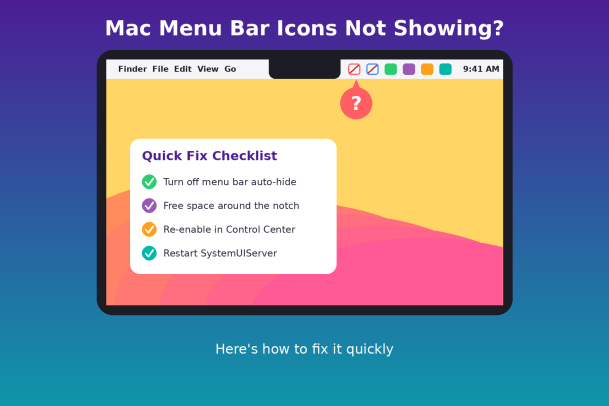
Mac menu bar icons not showing is usually a quick fix. Check auto-hide, clear space around the notch, re-enable icons in Control Center, and restart SystemUIServer. If that doesn’t work, update macOS, test Safe Mode or a new user account, and scan for malware.
But if security icons keep disappearing on your team’s Macs, the real question isn’t where the icon went. It’s whether your endpoints are still protected. Xcitium helps organizations secure every Mac and PC with Zero Trust endpoint protection that contains unknown threats automatically and gives your IT team full visibility from one console, even when a user can’t see a thing in the menu bar.
Don’t leave your endpoints to chance. See how Xcitium stops threats before they cause damage.
Please give us a star rating based on your experience.


 (27 votes, average: 2.44 out of 5, rated)