Every email sent, every cloud application accessed and every video call joined depends on one quiet piece of infrastructure: the router. It sits at the boundary between networks, deciding where each packet of data goes next. For most users it is invisible. For IT leaders and cybersecurity experts, it is one of the most strategically important and most frequently targeted devices in the entire environment.
So, what is a router, and why should it matter to the people responsible for keeping an organization secure? This guide explains how routers work, the main types you will encounter, how they differ from switches, modems and firewalls, and the security practices that keep them from becoming an attacker’s easiest way in.
What is a Router
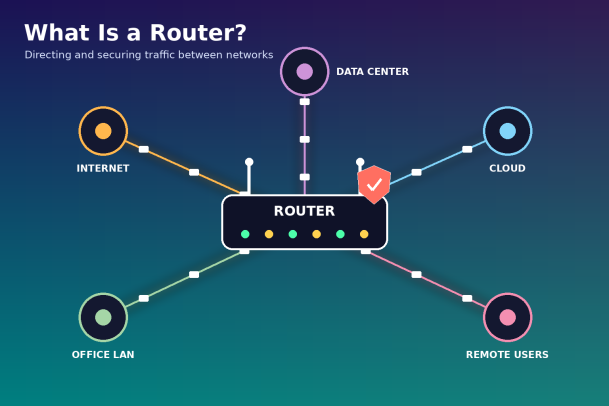
A router is a networking device that forwards data packets between two or more networks. It reads the destination IP address in each packet, consults its routing table, and sends the packet along the best available path toward its destination.
Think of a router as an air traffic controller for data. Switches move traffic within a single local network, but routers connect different networks together: your office LAN to the internet, a branch office to headquarters, or one cloud virtual network to another. Without routers, every network would be an isolated island.
Routers operate at Layer 3, the network layer, of the OSI model. That position gives them visibility into IP addressing and lets them make intelligent forwarding decisions. It also makes them a natural place to enforce policy, segment traffic and, unfortunately, a natural target for attackers.
How Does a Router Work
A router’s job comes down to four repeating steps, performed millions of times per second on enterprise hardware:
- Receive the packet. Data arrives on one of the router’s interfaces, broken into packets with a header that holds source and destination IP addresses.
- Read the destination. The router inspects the header and identifies where the packet needs to go.
- Consult the routing table. The routing table lists known networks and the best next hop to reach each one. Entries come from static routes configured by administrators or from dynamic routing protocols.
- Forward the packet. The router sends the packet out of the correct interface toward its next hop, repeating until it reaches its destination.
Routing protocols that keep tables current
- OSPF (Open Shortest Path First): a link-state protocol common inside enterprise networks that calculates the shortest path to each destination.
- BGP (Border Gateway Protocol): the protocol that routes traffic between autonomous systems across the internet. A BGP misconfiguration or hijack can reroute traffic at global scale.
- EIGRP and RIP: older or vendor-specific protocols still found in legacy environments.
Modern routers also perform Network Address Translation (NAT), which lets many private devices share one public IP address, and often handle DHCP, Quality of Service (QoS), VPN termination and basic access control lists (ACLs).
Types of Routers
Not every router plays the same role. Understanding the categories helps IT leaders map their attack surface accurately.
- Core routers: high-capacity devices at the heart of large enterprise or service provider networks, built for throughput and redundancy.
- Edge routers: sit at the network perimeter and connect the internal network to ISPs or other external networks. These are the most exposed to internet-based attacks.
- Branch routers: connect remote offices to headquarters or the cloud, often combining routing with VPN, firewall and SD-WAN functions.
- Virtual and cloud routers: software-based routers running in AWS, Azure, Google Cloud or on hypervisors. They route traffic between virtual networks and are configured through code and APIs.
- Wireless routers: combine routing with a Wi-Fi access point. Common in small offices and home offices, where many remote employees now work.
- SD-WAN appliances: centrally managed devices that route traffic dynamically across multiple links (MPLS, broadband, 5G) based on application policy.
Router vs. Switch vs. Modem vs. Firewall
These devices are often bundled together, which blurs the lines. Their core responsibilities remain distinct:
| Device | OSI layer | Primary job | Uses |
|---|---|---|---|
| Router | Layer 3 (network) | Forwards packets between different networks | IP addresses |
| Switch | Layer 2 (data link) | Connects devices within the same network | MAC addresses |
| Modem | Layer 1 (physical) | Converts signals between ISP line and digital data | Carrier signals |
| Firewall | Layers 3 to 7 | Inspects and allows or blocks traffic by security policy | Rules, signatures, context |
The key takeaway for security teams: a router decides where traffic goes, while a firewall decides whether it should go at all. Many routers include basic ACLs, but relying on them as your only security control leaves serious gaps.
Why Routers Are a Prime Target for Attackers
Routers see every packet that crosses a network boundary, often run for years without updates, and rarely support endpoint security agents. That combination makes them attractive to both cybercriminals and state-sponsored threat actors. Common attack vectors include:
- Unpatched firmware vulnerabilities: Many routers run outdated firmware with publicly known flaws that allow remote code execution or authentication bypass.
- Default or weak credentials: Factory passwords left unchanged remain one of the simplest routes to full device takeover.
- Exposed management interfaces: Web admin panels, Telnet, SSH or SNMP reachable from the internet give attackers a direct target.
- Router-based botnets: Compromised routers are recruited into botnets for DDoS attacks, credential stuffing and proxying malicious traffic. The Mirai family and its successors showed how fast this can scale.
- DNS hijacking: Attackers alter a router’s DNS settings to silently redirect users to phishing or malware sites.
- Man-in-the-middle attacks: A compromised router can intercept, read or modify unencrypted traffic.
- BGP hijacking and route leaks: Malicious or mistaken route announcements can divert traffic through hostile networks.
- Persistent implants: Advanced actors install firmware-level backdoors that survive reboots and evade most monitoring.
For an attacker, a compromised router is a beachhead. From there they can pivot to internal systems, harvest credentials and move laterally toward high-value endpoints and servers.
Router Security Best Practices
Hardening routers is basic hygiene, but it is consistently overlooked. These practices close the most common gaps:
- Keep a complete inventory. You cannot secure what you do not know exists. Track every physical, virtual and cloud router, its firmware version and its owner.
- Patch firmware promptly. Subscribe to vendor advisories and treat critical router vulnerabilities with the same urgency as server flaws. Replace end-of-life devices that no longer receive updates.
- Eliminate default credentials. Enforce strong, unique passwords, and use centralized authentication (TACACS+ or RADIUS) with multi-factor authentication for administrators.
- Lock down management access. Disable Telnet and HTTP, use SSH and HTTPS only, and restrict management to a dedicated out-of-band network or jump host.
- Disable unused services. Turn off UPnP, WPS, remote administration and unused protocols to shrink the attack surface.
- Segment the network. Use VLANs and routing policies to separate users, servers, IoT and guest traffic, so one compromise cannot reach everything.
- Secure routing protocols. Enable authentication for OSPF and BGP sessions, and apply route filtering and RPKI validation at the edge.
- Log and monitor continuously. Forward router logs to your SIEM, back up configurations, and alert on unexpected configuration changes, new admin accounts or unusual traffic flows.
Strategic Considerations for IT Leaders
Router security is not only a technical task; it is a governance decision. As networks stretch across offices, homes and multiple clouds, the traditional idea of a single trusted perimeter no longer holds.
Adopt a Zero Trust mindset. Assume any router, including your own edge devices, could be compromised. Verify every user, device and connection continuously rather than trusting traffic simply because it came from inside the network.
Extend protection to the endpoint. Even a perfectly hardened router cannot stop a malicious file a user opens, or an attacker who has already slipped past the perimeter. Endpoint protection that isolates unknown files and processes before they can cause harm provides a vital second line of defense.
Account for remote work. Employees’ home routers are now part of your extended attack surface, yet you rarely control them. Endpoint-centric security, secure access and DNS protection matter more than ever.
Plan for lifecycle and budget. Build router refresh cycles into your roadmap so end-of-life hardware does not linger as unpatched risk.
Frequently Asked Questions
What is a router in simple terms? A router is a device that connects different networks and directs data packets to their correct destination using IP addresses.
Is a router the same as a firewall? No. A router forwards traffic between networks, while a firewall inspects traffic and enforces security policy. Some devices combine both functions.
Can a router be hacked? Yes. Weak passwords, outdated firmware and exposed management interfaces make routers frequent targets for botnets, DNS hijacking and espionage.
How often should router firmware be updated? Apply critical security patches as soon as they are tested, and review firmware status at least monthly as part of routine vulnerability management.
Conclusion
Understanding what a router is goes far beyond knowing that it moves packets. Routers shape how your organization connects to the world, and a single misconfigured or unpatched device can open the door to a network-wide breach. Hardening routers, monitoring them closely and applying Zero Trust principles are essential steps.
But routers are only one layer. Attackers who get past the network edge will aim for your endpoints, where your data and users live. Xcitium’s Zero Trust endpoint protection isolates unknown threats in real time, so even when something slips through the network, it cannot do damage.
Ready to close the gaps your network can’t cover on its own? See how Xcitium stops threats before they execute.
Please give us a star rating based on your experience.

 (150 votes, average: 1.12 out of 5, rated)