What’s the Difference Between MDR and MSSP?
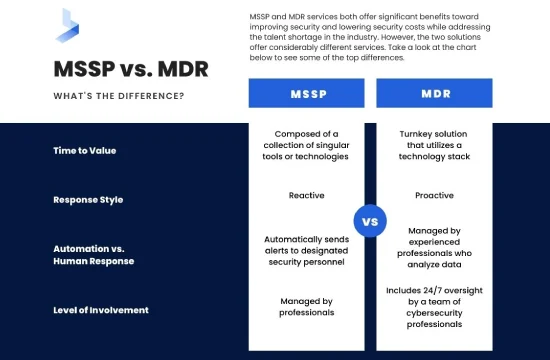
Managed Detection and Response (MDR) and Managed Security Service Providers (MSSP) are both essential components of modern cybersecurity, but they serve distinct purposes. While they may seem similar at first glance, their core functions, capabilities, and value propositions differ significantly. Understanding the difference between MDR and MSSP is critical for businesses looking to enhance their security posture.
MSSPs primarily focus on providing security monitoring, alerting, and compliance-driven services. They oversee security tools, manage firewalls, and monitor logs for suspicious activity, but their involvement often stops at sending alerts to the client. MSSPs typically offer a broad range of security services such as vulnerability management, compliance reporting, and threat intelligence. However, they do not actively investigate or respond to threats in real time. Instead, MSSPs act as an outsourced security operations center (SOC) that provides visibility into an organization's security landscape but leaves incident response and mitigation largely in the hands of the internal IT team.
MDR, on the other hand, takes a more hands-on approach to cybersecurity. It goes beyond just monitoring by actively detecting, investigating, and responding to cyber threats. MDR providers use advanced threat-hunting techniques, artificial intelligence, and behavioral analytics to identify sophisticated attacks that traditional security tools might miss. One of the most significant advantages of MDR is its focus on rapid incident response. Instead of merely alerting the client about potential threats, MDR providers take direct action to contain and neutralize attacks, often in real time. This proactive approach significantly reduces the dwell time of threats and minimizes the potential damage from cyber incidents.
Another key difference between MDR and MSSP lies in automation and analytics. MDR services leverage AI-driven threat intelligence and behavioral analysis to detect anomalies and respond swiftly to emerging threats. MSSPs, while providing essential security services, often rely more on human analysis and predefined rules to identify security incidents, which can result in delayed response times.
Additionally, MDR solutions are designed for organizations that require an advanced level of cybersecurity expertise but lack the internal resources to handle sophisticated threats. MSSPs, in contrast, are well-suited for businesses that need security monitoring and compliance support but prefer to manage their own incident response.
Ultimately, the choice between MDR and MSSP depends on an organization’s security needs. If a company requires continuous threat hunting and active response capabilities, MDR is the ideal solution. If the goal is to enhance security monitoring and maintain compliance, an MSSP may be a better fit.
How MDR Enhances Threat Response Compared to MSSP
Managed Detection and Response (MDR) significantly enhances threat response compared to a traditional Managed Security Service Provider (MSSP) by offering real-time detection, investigation, and active mitigation of cyber threats. While both MDR and MSSP contribute to an organization's cybersecurity framework, MDR provides a proactive, hands-on approach that goes beyond monitoring and alerting.
One of the primary ways MDR improves threat response is through advanced threat hunting and behavioral analytics. MDR providers leverage artificial intelligence, machine learning, and deep behavioral analysis to identify threats that traditional security measures may miss. By continuously analyzing network activity, user behavior, and endpoint data, MDR can detect anomalies that could indicate potential cyberattacks before they escalate. MSSPs, in contrast, typically rely on predefined security rules and log monitoring, which may not be effective against sophisticated threats that evolve rapidly.
Another key advantage of MDR is its focus on rapid incident response. Unlike an MSSP, which primarily provides alerts when a threat is detected, MDR actively intervenes to contain and mitigate threats. MDR providers have dedicated security analysts and automated response mechanisms that can isolate compromised endpoints, shut down malicious processes, and take corrective actions in real time. This swift response minimizes the impact of cyber incidents and prevents attackers from moving laterally within a network. MSSPs, on the other hand, often leave incident response responsibilities to the internal IT team, which can lead to delays in addressing security breaches.
MDR also excels in providing actionable intelligence and forensic analysis. When a security event occurs, MDR providers conduct in-depth investigations to understand the nature of the attack, the tactics used by threat actors, and the vulnerabilities exploited. This detailed analysis helps organizations strengthen their defenses and prevent similar attacks in the future. MSSPs, while capable of providing security reports and compliance monitoring, generally do not offer the same level of investigative insight or remediation support.
Another differentiator is the use of automation in threat response. MDR platforms leverage automated security playbooks and AI-driven response mechanisms to take immediate action against detected threats. This automation reduces reliance on human intervention and ensures a faster, more efficient response to cyber incidents. MSSPs, in contrast, often rely on manual processes and client-initiated actions, leading to slower mitigation times.
Ultimately, MDR enhances threat response by providing a proactive, hands-on approach to cybersecurity. By combining real-time detection, automated response, and expert analysis, MDR minimizes the risk of cyber threats, ensuring a stronger security posture compared to the more passive approach of an MSSP. Organizations that require continuous protection and rapid incident response will benefit significantly from MDR’s advanced capabilities.
Why MSSPs Are Not a Replacement for MDR
Managed Security Service Providers (MSSPs) and Managed Detection and Response (MDR) serve different roles in cybersecurity, and while MSSPs provide valuable security monitoring and management, they are not a replacement for MDR. The core difference lies in their approach to threat detection, response, and mitigation. MSSPs focus on monitoring security events and providing alerts, whereas MDR actively detects, investigates, and responds to threats in real time.
One of the main reasons MSSPs cannot replace MDR is their reactive nature. MSSPs primarily act as an outsourced Security Operations Center (SOC),managing security tools, monitoring logs, and sending alerts when potential threats are detected. However, they do not actively investigate incidents or take immediate action to contain threats. Instead, MSSPs rely on the client’s internal IT team to respond to security incidents. This delay in response can be critical, as cyber threats evolve quickly and require immediate action to prevent widespread damage.
MDR, on the other hand, is built for active threat detection and response. It combines advanced analytics, artificial intelligence, and security expertise to proactively hunt for threats, analyze attack patterns, and mitigate risks before they escalate. MDR providers not only detect threats but also take immediate action to contain and neutralize them, significantly reducing the dwell time of attackers within a network.
Another key limitation of MSSPs is their reliance on traditional security tools and rule-based detection. Many MSSPs use predefined signatures and indicators of compromise (IoCs) to identify threats. While this method is effective for known threats, it falls short against sophisticated, evolving attacks that leverage zero-day vulnerabilities or advanced persistent threats (APTs). MDR providers, in contrast, employ behavior-based detection and continuous threat hunting to identify anomalies that may indicate a breach, even if no known signatures exist.
MSSPs also focus heavily on compliance and security monitoring rather than proactive cybersecurity. While compliance is important, it does not equate to effective threat detection and response. MSSPs provide security reports, log management, and firewall monitoring, but they lack the hands-on threat containment and remediation that MDR offers. Businesses that rely solely on an MSSP may find themselves unprepared to handle an active cyberattack without an internal team to investigate and mitigate threats.
Ultimately, MSSPs play a crucial role in cybersecurity, but they should not be viewed as a substitute for MDR. Organizations that require proactive threat hunting, rapid incident response, and real-time containment need MDR to complement their security strategy. While MSSPs provide visibility and security management, MDR delivers the hands-on protection necessary to combat today’s evolving cyber threats effectively.